 admin
adminThinking of withdrawing your Provident Fund? Before you click that withdraw button, it pays to know exactly when your PF is tax-free, when TDS gets deducted, and how the money is taxed in your hands. One wrong move can cost you tax you never expected. Here is the complete clarity, the way our team explains it to clients every day.
The single rule that decides everything: 5 years of continuous service
The taxability of your EPF withdrawal hinges on one question — have you completed 5 years of continuous service?
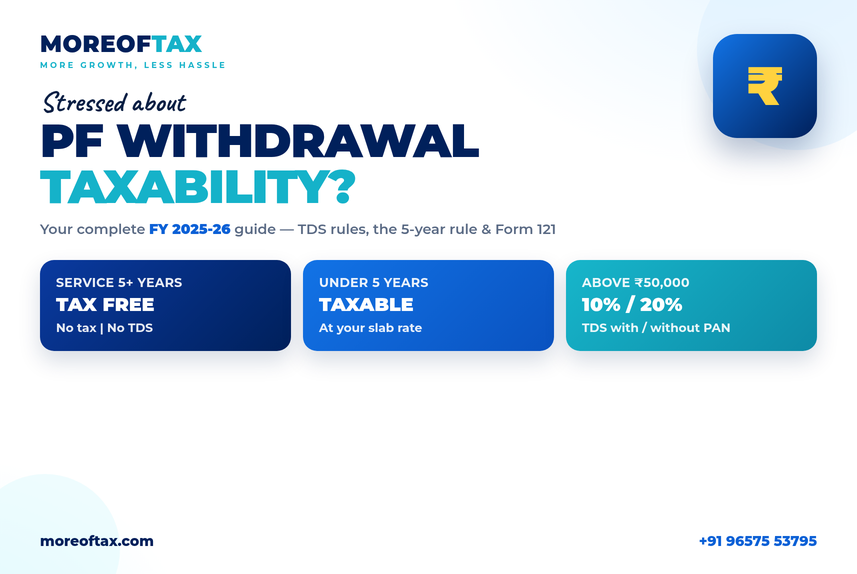
- Service of 5 years or more: The entire accumulated balance — your contribution, your employer’s contribution and all interest earned — is fully exempt under Section 10(12). There is no tax and no TDS, and you do not need to report it.
- Service of less than 5 years: The withdrawal becomes taxable at your slab rate, and TDS may apply. This is where most people get caught off guard.
Tip: “Continuous service” includes time with a previous employer if you transferred your EPF balance instead of withdrawing it. Job changes do not reset the clock — withdrawals do.
If service is less than 5 years: when is TDS deducted?
For a premature withdrawal, TDS is governed by Section 192A. Whether tax is deducted depends on the amount and on your PAN:
- Withdrawal up to ₹50,000: No TDS is deducted. But the amount is still taxable — report it in your ITR and pay tax as per your slab.
- Withdrawal above ₹50,000, PAN available: TDS at 10%.
- Withdrawal above ₹50,000, PAN not available: TDS at 20%.
Remember: TDS is not your final tax. It is only an advance deduction. Your actual liability is decided when you file your return — so you may get a refund, or you may have to pay a little more.
Exceptions: tax-free even before 5 years
Sometimes life forces an early exit, and the law allows for it. Your withdrawal can be fully exempt even before 5 years when the service ends because of:
- Job loss or retrenchment beyond your control
- Ill health of the employee
- Discontinuation or closure of the employer’s business
- Any other reason not within your control
To claim this relief, keep documentary proof and submit it to the EPFO.
How a taxable PF withdrawal is taxed — component by component
When the withdrawal is taxable (service under 5 years), it is not taxed as a single lump sum. Each component is treated differently:
| Component of withdrawal | How it is taxed |
|---|---|
| Your own (employee) contribution | Taxable only to the extent you claimed a deduction under Section 80C in earlier years |
| Interest on your contribution | Taxable under “Income from Other Sources” |
| Employer’s contribution | Taxable as “Salary” (profit in lieu of salary) |
| Interest on employer’s contribution | Taxable as “Salary” |
Form 121: how to legally avoid TDS
If your total income for the year — including the PF withdrawal — stays below the basic exemption limit, your final tax is nil, and you can avoid TDS with a self-declaration. From FY 2026-27, under the Income-tax Act, 2025, this declaration is made through the new Form 121, which replaces the earlier Forms 15G and 15H for PF withdrawals.
- Use it only if your total income (including the withdrawal) is below the taxable limit.
- Your final tax liability must genuinely be NIL — a wrong declaration can attract penalties.
- Keep the Form 121 acknowledgement for your records.
Documents to keep ready
- PAN linked with Aadhaar and updated in your EPFO account
- Form 16C (TDS certificate)
- PF passbook
- Proof supporting any exception claim (illness, retrenchment, closure, etc.)
- Form 121 acknowledgement (if submitted)
The bottom line
Complete 5 years and your PF is entirely tax-free. Withdraw earlier and the rules tighten: amounts over ₹50,000 attract 10% TDS (20% without PAN), the whole sum is taxable at slab, and the final number depends on your total income. A little planning around timing and documentation can save you a real amount of tax.
Not sure how your withdrawal will be taxed?
Get a personalised PF tax check from MoreofTax. Call +91 96575 53795 or write to contact@moreoftax.com. You can also try our free TDS Calculator and Income Tax Calculator.
Related Articles
- ITR Filing AY 2026-27: Which Form to File
- Old vs New Tax Regime FY 2025-26
- Advance Tax FY 2025-26: Due Dates & Calculation
- GST Registration: Who Needs It & Process
- TDS on Salary (Section 192)
- NRI Taxation & FEMA Basics
Frequently Asked Questions
Is PF withdrawal taxable after 5 years?
No. If you have completed 5 years of continuous service, the entire EPF withdrawal — employee contribution, employer contribution and interest — is fully exempt under Section 10(12). There is no tax and no TDS.
How much TDS is deducted on PF withdrawal before 5 years?
If the withdrawal is more than ₹50,000 and service is under 5 years, TDS is 10% when your PAN is available and 20% when it is not. Withdrawals up to ₹50,000 attract no TDS, though the amount remains taxable in your ITR.
Is the ₹50,000 limit for TDS the same as being tax-free?
No. The ₹50,000 threshold only decides whether TDS is deducted. A withdrawal under ₹50,000 (with service below 5 years) still has to be reported and taxed at your slab rate when you file your return.
Can I avoid TDS on PF withdrawal?
Yes, if your total income including the withdrawal is below the basic exemption limit and your final tax is nil. From FY 2026-27 you submit Form 121 (which replaces Forms 15G and 15H) to declare this and avoid TDS.
What happens if I withdraw PF before 5 years due to job loss?
If your service ended due to retrenchment, ill health, your employer’s business closing, or another reason beyond your control, the withdrawal can be fully exempt even before 5 years. Keep proof and submit it to the EPFO.