 admin
adminLiving abroad but earning or investing in India? Your tax depends first on your residential status, then on where your income arises. Add FEMA rules on bank accounts and repatriation, and NRI compliance can get tricky. Here are the essentials.
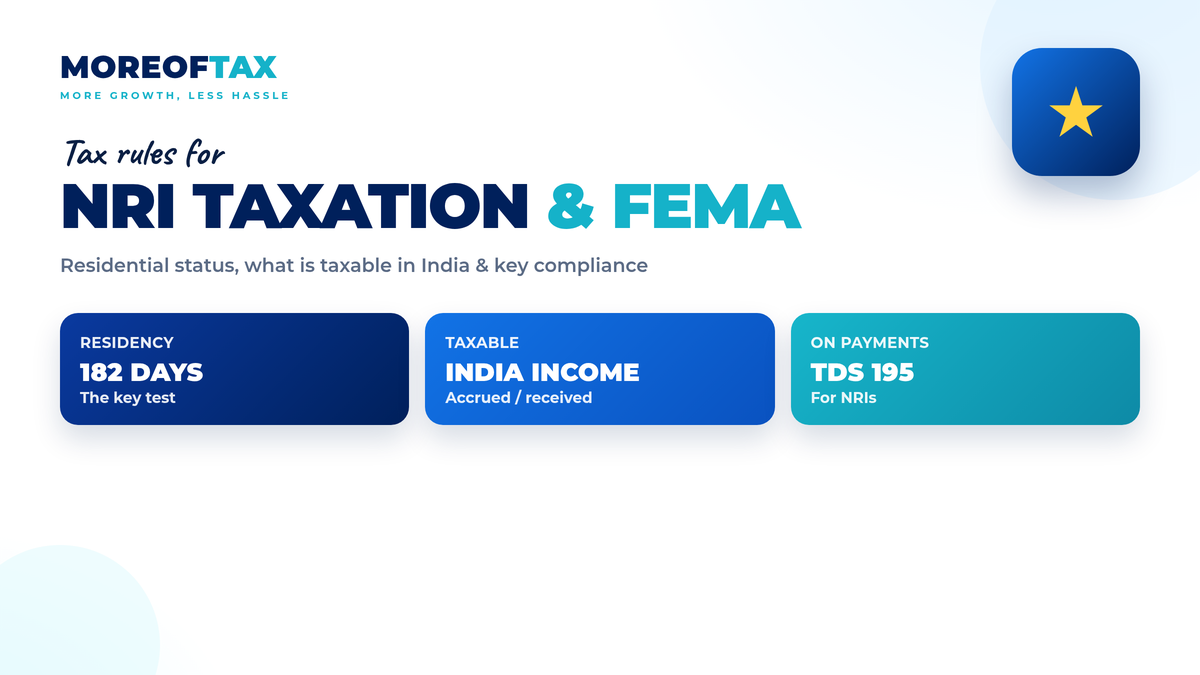
Step 1: Determine your residential status
Under the Income-tax Act, you are a Resident if you are in India for 182 days or more in the financial year, or 60 days or more in the year and 365 days or more across the previous four years. If you do not meet these tests, you are a Non-Resident (NRI). Indian citizens leaving for employment abroad get the more relaxed 182-day test.
A middle category, RNOR (Resident but Not Ordinarily Resident), applies in transition years and to certain high-income Indian citizens not taxed elsewhere — it offers partial relief on foreign income.
Step 2: What is taxable in India
An NRI is taxed only on income that is received, accrues, or arises in India (or is deemed to). Your foreign salary and foreign investments are not taxed in India. Income taxable in India typically includes:
- Salary for services rendered in India
- Rent from property located in India
- Capital gains on Indian shares, mutual funds and property
- Interest from an NRO account or Indian deposits
Importantly, interest on NRE and FCNR accounts is exempt from tax in India.
Step 3: TDS and DTAA relief
Payments to NRIs are subject to TDS under Section 195, with rates depending on the income type (for example, TDS on capital gains when an NRI sells property). To avoid being taxed twice, NRIs can claim relief under a Double Taxation Avoidance Agreement (DTAA) by furnishing a Tax Residency Certificate (TRC) and Form 10F, often reducing the Indian tax rate.
FEMA: accounts and repatriation
FEMA governs how NRIs bank and invest in India. On becoming an NRI you must convert resident savings accounts to NRO accounts, and you can hold NRE and FCNR accounts for foreign earnings. NRE funds are freely repatriable; NRO repatriation is capped (up to USD 1 million per financial year) and requires Forms 15CA/15CB. NRIs can invest in Indian property (except agricultural land) and markets within FEMA limits.
MoreofTax specialises in NRI taxation, DTAA relief and FEMA compliance. Call +91 96575 53795 or email contact@moreoftax.com.
Related Articles
- ITR Filing AY 2026-27: Which Form to File
- Old vs New Tax Regime FY 2025-26
- Advance Tax FY 2025-26: Due Dates & Calculation
- GST Registration: Who Needs It & Process
- TDS on Salary (Section 192)
- PF Withdrawal Taxability Explained
Frequently Asked Questions
Is an NRI taxed on foreign income in India?
No. An NRI is taxed in India only on income received, accruing or arising in India. Foreign salary and foreign investment income are not taxable in India.
Is NRE account interest taxable?
No. Interest earned on NRE and FCNR accounts is exempt from income tax in India. Interest on NRO accounts is taxable.
How can an NRI avoid double taxation?
By claiming benefits under the relevant DTAA, supported by a Tax Residency Certificate and Form 10F, which can lower or offset the Indian tax on the same income.