 admin
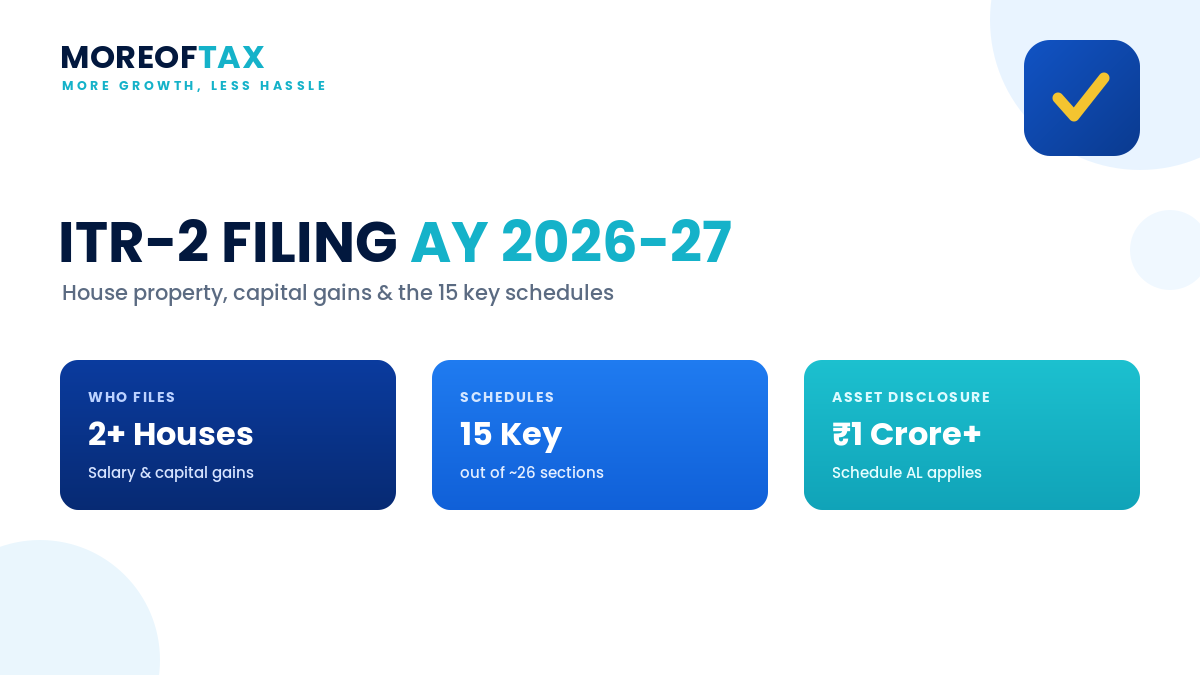
adminThe ITR-2 form looks intimidating the first time you open it. There are roughly 26 sections inside, and most people assume every one of them needs to be filled. The good news: you only deal with the schedules that actually apply to your income. Below is a clear, jargon-free walkthrough of the 15 schedules that matter most for AY 2026-27.
ITR-2 is meant for individuals and HUFs — resident or non-resident — who earn from salary, more than one house property, capital gains, or other sources (including income taxed at special rates), but who have no income from a business or profession. If that describes you, the form is already live on the income tax e-filing portal.
1. Part A – General
Confirm the details the portal has already pulled from your profile — contact information, filing status, residential status and bank details. For AY 2026-27 the status is auto-set to “Filed u/s 139(1)”. Because the new tax regime is now the default, the opt-out question under Section 115BAC(6) defaults to “No”. Switch it to “Yes” only if you want to stay on the old regime.
2. Bank Details
Add every bank account you hold — a step many taxpayers skip. At least one account must be pre-validated on the portal, otherwise any refund due to you cannot be credited.
3. Schedule House Property
Report property that is self-occupied, let out or deemed let out. Depending on your situation you will enter co-owner details, tenant details, rent received, interest on a home loan and any pass-through income.
4. Schedule Capital Gains
This schedule separates gains by the type of asset sold. Where you have sold more than one asset of the same type, you report a single consolidated computation. The exception is land and buildings — each property is entered individually. You will also record short-term and long-term gains or losses across all asset categories.
5. Schedule VDA
A newer addition: report income from the transfer of Virtual Digital Assets (crypto, NFTs and the like) here. Whatever you enter automatically flows into the Capital Gains schedule.
6. Schedule CYLA
Current Year Loss Adjustment shows your income after current-year losses are set off. Anything left unabsorbed moves on to Schedule CFL to be carried forward.
7. Schedule BFLA
Brought Forward Loss Adjustment displays your income after setting off losses carried over from previous years.
8. Schedule CFL
Carry Forward of Losses lists the losses you are carrying into future years, so they are available to offset later gains.
9. Schedule VI-A
Claim and verify deductions such as 80C, 80D and similar here. Note that most of these deductions do not apply if you are filing under the new regime.
10. Schedule SPI
For income that must be clubbed with yours under Section 64 — for example certain income of a spouse or minor child — this is where it is reported.
11. Schedule FSI
Foreign Source Income captures income arising outside India. This schedule is available to residents only.
12. Schedule TR
Tax Relief summarises the credit you are claiming in India for taxes already paid abroad, country by country. It ties back to the detail you entered in Schedule FSI.
13. Schedule FA
Foreign Assets requires resident taxpayers to disclose foreign assets and overseas income. You can skip it if you are a Not Ordinarily Resident or a Non-Resident.
14. Schedule 5A
A niche one: it apportions income between spouses for taxpayers governed by the community-of-property system under the Portuguese Civil Code, 1860 (largely relevant in Goa).
15. Schedule AL
Assets and Liabilities is mandatory if your total income crosses ₹1 crore. You disclose movable and immovable assets along with related liabilities. Non-residents and RNORs report only assets located in India.
Quick tip: Before you start, reconcile your AIS and Form 26AS with your own records — especially capital gains from stocks and mutual funds. Mismatches are the single most common reason returns get flagged.
Need help filing ITR-2?
Not sure which schedules apply to you? Our Chartered Accountants file ITR-2 accurately, claim every deduction you are entitled to, and handle the portal end-to-end. Book your free consultation or call +91 96575 53795.
This article is for general information and is not a substitute for professional tax advice.